
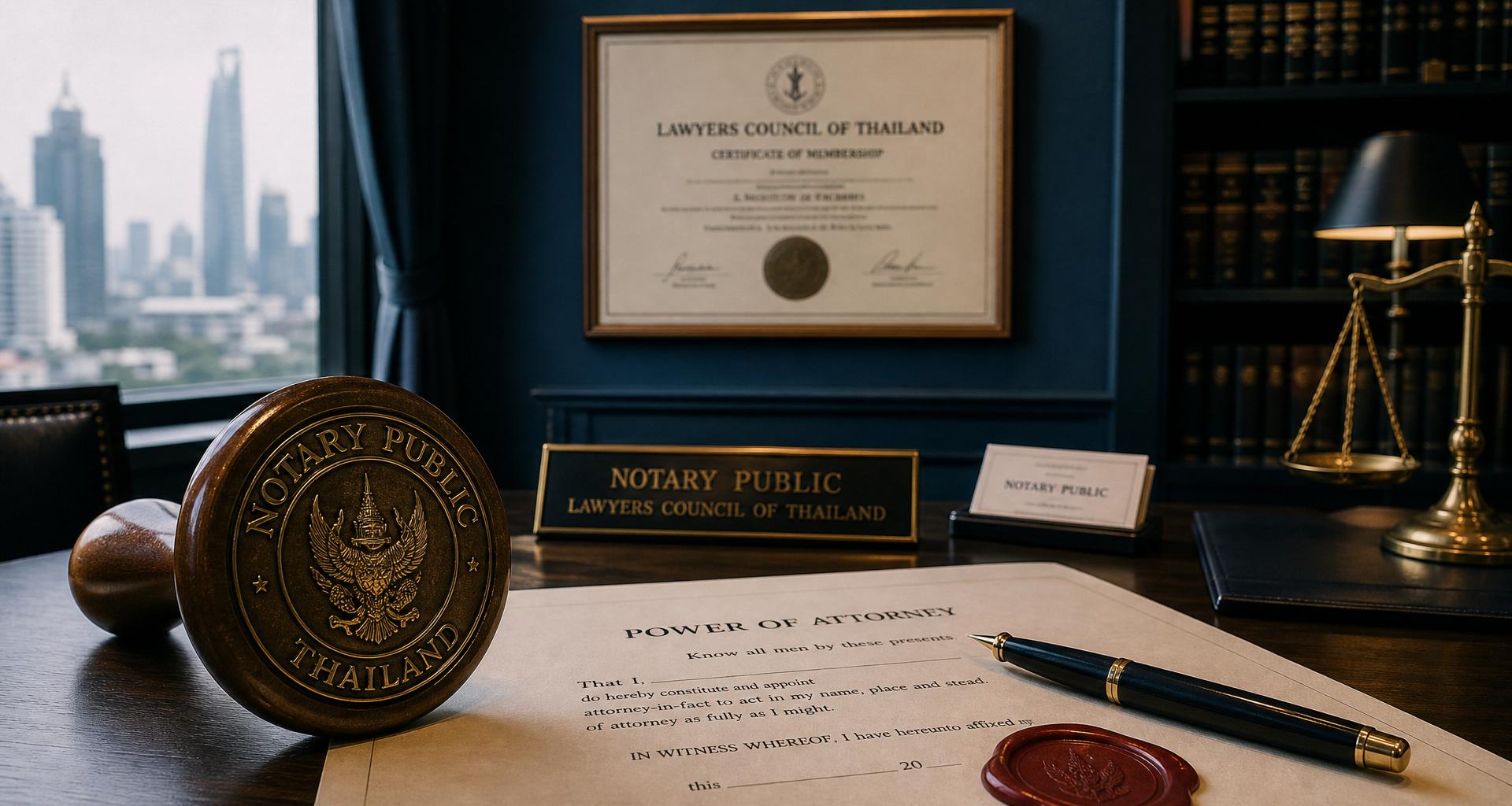
60-Second Answer (URGENT — Deadline Sensitive)
iVC provides Notarial Protest of Instruments in Bangkok for dishonored cheques, bills of exchange, and promissory notes — preserves your right to sue the drawer and all endorsers in international courts. CRITICAL: file within 24-48 hours of dishonor under Thai CCC, UK Bills of Exchange Act 1882, Singapore/HK BoE Ordinance — failure to protest = loss of recourse against endorsers. Our Lawyers Council of Thailand Notarial Services Attorney executes formal Protest + Notice of Dishonor, then Apostille at MOFA (post-Hague 2026) for direct admission as prima facie evidence in 125 Hague country courts. Standard contact us for a quote, urgent same-day +50%, full international package (Protest + Apostille + DHL to UK/SG/HK solicitor) contact us for a quote. Turnaround 24-72 hours for Protest, 5-7 days for full international filing.
Legal Basis for Notarial Services in Thailand
Thailand has no US/UK-style "Notary Public." Instead, the Lawyers Council of Thailand Act B.E. 2528 (1985) and the Regulation of the Lawyers Council on Registration and Performance of Duties of Notarial Services Attorneys B.E. 2551 (2008) authorize specially-trained, Council-registered attorneys — "Notarial Services Attorneys" — to witness signatures, administer oaths, certify copies, and protest instruments for use abroad. Powers of Attorney must meet the form requirements of Section 798 of the Civil and Commercial Code; protest of a dishonoured cheque or bill of exchange follows Sections 959-990 of the same Code. Clients can verify a Notarial Services Attorney's registration directly with the Lawyers Council of Thailand (lawsociety.or.th) and confirm onward legalization requirements with the Consular Affairs Department, Ministry of Foreign Affairs (mfa.go.th).
Documents to Prepare & Common Use Cases
- Original passport for every signatory appearing before the Notarial Services Attorney
- Original document or true copy to be certified, plus a certified translation where the destination country requires one
- Company Affidavit from the Department of Business Development (DBD), issued within the last 30-90 days, for corporate documents
- A clear statement of purpose: visa or work-permit application, overseas property purchase/sale, company registration or director change, court proceedings, or inheritance/probate matters
Typical use cases include visa and immigration filings that require a sworn or certified document, cross-border real estate transactions where the owner cannot appear in person, and corporate transactions that must be recognized by a foreign company registry or bank. After notarization, most documents still need to pass through the Consular Affairs Department (MOFA) for Apostille or legalization before they are fully valid overseas — plan an additional few business days for this step.
International Legal Framework Governing Protest of Instruments
Formal protest of a dishonored bill of exchange, promissory note, or cheque has deep roots in international commercial law. Many common-law jurisdictions still follow rules derived from the UK Bills of Exchange Act 1882 (adopted with local variations in Singapore, Hong Kong, Malaysia, and other Commonwealth jurisdictions), while civil-law jurisdictions generally apply principles consistent with the 1930 Geneva Convention providing a Uniform Law for Bills of Exchange and Promissory Notes. In Thailand, the governing provisions are Sections 959 through 990 of the Civil and Commercial Code, which set out the formal requirements for protest and the consequences of failing to protest in time. A Notarial Services Attorney registered with the Lawyers Council of Thailand (lawsociety.or.th) is the officer authorized under Thai practice to draw up the formal Protest Certificate recording presentment, dishonor, and the holder's demand.
The common thread across these legal systems is strict time sensitivity: protest generally must occur on the day of dishonor or the next business day to preserve the holder's recourse against endorsers and the drawer. A Protest Certificate executed late may still have evidentiary value, but it typically no longer preserves recourse rights against parties who would otherwise be discharged by delay. Once the Protest Certificate and accompanying Notice of Dishonor are notarized in Bangkok, iVC arranges an MOFA Apostille through the Department of Consular Affairs for use in any of the 125+ Hague Convention member states (confirm current membership at hcch.net), or full consular legalization for the smaller number of non-Hague destinations, before dispatching the documents to the client's foreign solicitor or litigation counsel.
FAQ
What is a Notarial Protest of Instruments and when do I need it?
A Notarial Protest of Instruments (also called Protest for Non-Payment or Protest for Non-Acceptance) is a formal notarial act under the Bills of Exchange Act and international Geneva Convention on Bills of Exchange (1930) where a Notary Public formally records that a negotiable instrument — bill of exchange, promissory note, cheque, or banker's draft — has been presented for payment/acceptance and dishonored. The protest creates prima facie evidence in court proceedings (Thai and foreign) that the drawer/maker and all endorsers are liable. You need it when: (1) a foreign customer's USD/EUR cheque to your Thai company is dishonored ('Refer to Drawer' / 'Insufficient Funds' / 'Stop Payment'); (2) a bill of exchange drawn on a London/Singapore/HK bank is dishonored on presentation; (3) a promissory note issued by a foreign party for a Thai loan is not paid at maturity; (4) you need to preserve recourse rights against endorsers (without protest within 24-48 hours of dishonor, recourse against endorsers may be lost under foreign laws); (5) you intend to sue in a foreign court (UK, HK, Singapore, US — all common law jurisdictions require notarial protest for international bills).
What is the legal deadline to file a Protest after dishonor?
Critical deadlines vary by jurisdiction and instrument type: (1) Thai Civil & Commercial Code (Section 982-987) — protest must be made on the day of dishonor OR the next business day for inland bills; foreign bills have until the next business day after the day for presentment for acceptance/payment — failure to protest within deadline = loss of recourse against endorsers (drawer remains liable) (2) UK Bills of Exchange Act 1882 — foreign bills MUST be protested for non-acceptance/non-payment on the day of dishonor or the next business day (3) US UCC Article 3 — protest not strictly required for domestic, but international convention/contract usually requires it (4) Geneva Convention 1930 (UNIDROIT) — applies to most European bills, requires protest within 2 business days of dishonor (5) Singapore Bills of Exchange Act — same as UK pattern (6) Hong Kong Bills of Exchange Ordinance — same as UK. iVC recommendation: file protest within 24 hours of dishonor regardless of jurisdiction — preserves all options. We offer same-day urgent protest service for time-critical instruments.
What documents and information do I need to bring to iVC?
Required for Protest filing: (1) Original dishonored instrument (cheque/bill/note) — must bring physical original, not a copy (2) Bank's dishonor advice / return memo — written notice from drawee bank stating reason for dishonor ('Refer to Drawer', 'Insufficient Funds', 'Stop Payment', 'Account Closed', 'Signature Differs') (3) Original face deposit slip / presentation receipt — proves date of presentation (4) Holder's identification — passport + proof of corporate authority if held by company (5) Underlying contract — sales contract, invoice, or loan agreement showing why the instrument was issued (6) Endorsement chain — list of all endorsers if instrument was negotiated multiple times (7) Drawer's last known address — for service of protest notice. iVC drafts: (a) formal Notarial Protest Certificate; (b) Notice of Dishonor to drawer + endorsers; (c) cover letter for foreign court filing; (d) Apostille-ready format for cross-border enforcement.
What is the difference between Protest for Non-Acceptance vs Non-Payment?
Two distinct protest types under bills of exchange law: (1) Protest for Non-Acceptance — applies ONLY to bills of exchange (not cheques) — when a bill is presented to the drawee for acceptance and the drawee refuses to accept (refuses to commit to pay at maturity). Filed immediately on refusal. Preserves right to immediate recourse against drawer/endorsers BEFORE maturity date (2) Protest for Non-Payment — applies to all instruments (cheques, bills, notes) — when instrument is presented at maturity for payment and payment is refused. Filed on day of dishonor or next business day. Preserves right to recover principal + interest + costs from drawer/endorsers. Practical scenarios: dishonored cheque = Protest for Non-Payment (cheques are payable on demand, no acceptance stage). Bill of exchange drawn 90 days after sight, drawee refuses to accept on presentment = Protest for Non-Acceptance + later Protest for Non-Payment if not paid. iVC files BOTH protests on the same instrument when applicable — required for full international recourse.
How does Apostille (post-Hague 2026) help international debt recovery?
Major workflow improvement since 1 Jan 2026 for cross-border debt recovery: (1) iVC issues Notarial Protest under Lawyers Council of Thailand seal (2) MOFA Chaeng Watthana Apostille — single stamp — accepted in 125 Hague countries as prima facie evidence in court without further authentication (3) File suit in foreign court (UK High Court, Singapore High Court, HK Court of First Instance, Australian Federal Court) with Apostilled Protest as evidence. Pre-2026 workflow required: Protest → MOFA → destination embassy in Bangkok → DHL → foreign court — taking 14-28 days. Post-2026 (now): Protest → MOFA Apostille → DHL → foreign court — 5-7 days. Hague countries enforcing this: UK, Singapore, HK, Australia, NZ, US, Canada, Germany, France, Italy, Spain, Netherlands, Belgium, Switzerland, Japan, South Korea, India, Brazil, Mexico, Argentina, South Africa, UAE (post-2014). Non-Hague enforcement (China, Vietnam, Saudi Arabia): still requires embassy legalization + may need separate sworn statement under foreign attorney.
Pricing and turnaround for urgent international debt recovery
Notarial Protest fees: (1) Standard Protest for Non-Payment (single instrument): contact us for a quote — includes drafting, notarial act, 3 originals, Notice of Dishonor (2) Protest for Non-Acceptance + Non-Payment (combined): 8,500 THB (3) Multi-instrument batch (5+ cheques from same drawer): 4,500 THB each (4) Urgent same-day protest (within 24 hours): +50% surcharge (essential for preserving recourse). Apostille add-on: contact us for a quote + 3-5 working days (urgent same-day Apostille +50%). Non-Hague embassy legalization: contact us for a quote + 5-10 days. Foreign attorney coordination (UK solicitor, Singapore/HK barrister, US attorney for court filing): iVC has direct partners — coordination fee contact us for a quote + foreign attorney's own fees. DHL international courier: contact us for a quote. Typical full package (Protest + Apostille + DHL to UK solicitor): contact us for a quote + foreign attorney fees. Turnaround 24-72 hours for Protest + 5-7 days end-to-end including Apostille.