
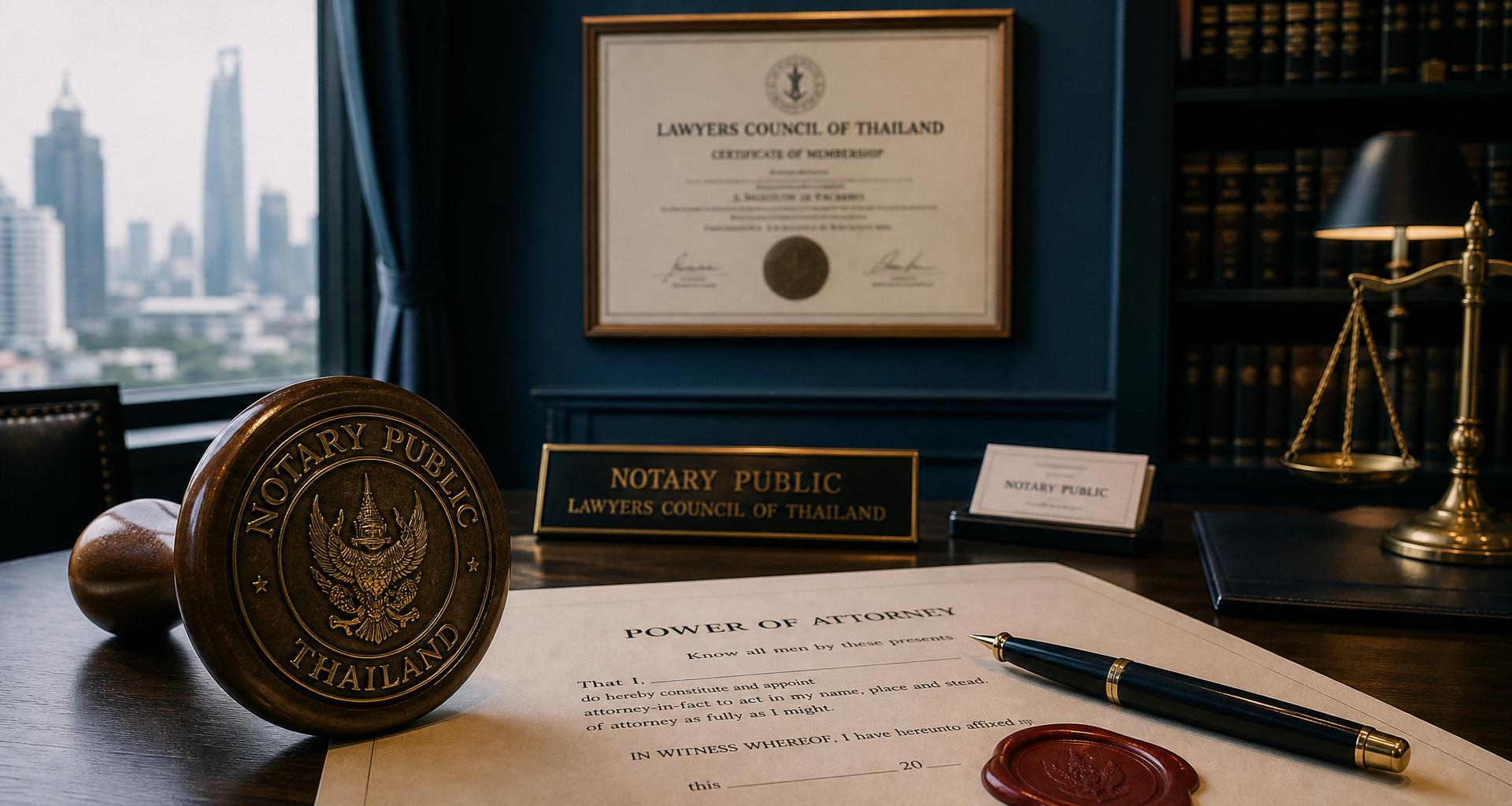
Notarial Services Attorney (Notary Public) Thailand ⚖️
iVC 2025
Notarisation by a 'Notarial Services Attorney' — a lawyer registered with the Lawyers Council of Thailand under its Regulation on the Registration of Notarial Services Attorneys B.E. 2551 (2008). Thailand is not a party to the Hague Apostille Convention, but the Notarial Services Attorney system is the internationally-recognised authentication path used before onward legalisation at Thailand's Department of Consular Affairs (MFA/DCA) and the destination embassy.
Quick answer: Notarial Services Attorney (Notary Public) Thailand
"รับรองเอกสารโดย Notarial Services Attorney · Fees THB 500–3,500. Suited to: Foreigners and Thai nationals needing signature/copy/translation/oath notarisation for use with foreign authorities, embassies, courts, banks, cross-border corporate registrations, and visa/study applications."
- 01Is Thai notarisation accepted in the United States?
- Yes, after downstream MFA legalisation and legalisation at the Royal Thai Embassy or a US Consulate. Most US state authorities accept the resulting chain of authentication for probate, real estate, and corporate filings.
- 02Can you notarise a document in English?
- Yes. Notarial Services Attorneys are licensed to certify signatures and copies in any language they can read. Documents in other languages typically require a certified Thai translation first.
- 03Do I have to sign in front of the notary?
- Yes for signature certification. Certified copies, oaths, and affirmations also require personal presence. Corporate documents may be signed elsewhere if a director's signature is separately notarised abroad.
- 04How does this compare to a US Notary Public?
- A Thai Notarial Services Attorney is more restricted — only lawyers who complete Lawyers Council training and register are eligible. US Notaries Public cannot practise in Thailand for documents intended for the Thai legal system.
แหล่งข้อมูล:iVC — International Visa Center · ข้อมูลปรับปรุง 2026
Scope of services
- 1.Signature notarisation (in-person, in English or Thai)
- 2.Certified true copy of original documents
- 3.Translation certification (translator-affidavit style)
- 4.Oath / affirmation / statutory declaration
- 5.Power of attorney authentication
- 6.Corporate document notarisation (board resolutions, incumbency certificates)
- 7.Signature witness for international real estate, IP assignment, and estate documents
- 8.Downstream MFA legalisation and embassy legalisation coordination
Compliance & Legal Basis
- §Lawyers Council Regulation on the Registration of Notarial Services Attorneys B.E. 2551 (2008)
- §Ministerial Regulation on the Practice of Notarial Services (2005)
- §Department of Consular Affairs legalisation procedure (Consular Section 3, Chaeng Watthana)
- §Country-specific embassy legalisation requirements (US, UK, Schengen, Australia, Canada, Japan, Korea, China)
- §Note: Thailand is NOT a Hague Apostille Convention state — apostille cannot be issued in Thailand; use MFA legalisation instead
Timeline
- Same dayIn-office notarisation (Bangkok) — walk-in or 2-hour appointment.
- 1–3 business daysProvincial mobile notary (travel fee applies).
- +3–7 business daysMFA legalisation at Consular Affairs, Chaeng Watthana.
- +5–20 business daysEmbassy legalisation (varies by country).
Deliverables
- ✓Notarial certificate affixed to the original document
- ✓Lawyer's seal, signature and registration number
- ✓Notary log entry (retained 5 years per Lawyers Council rule)
- ✓Optional: onward MFA + embassy legalisation with tracking
iVC Edge
- ★Bilingual Notarial Services Attorneys — no need to bring your own translator
- ★Same-day service for standard documents in central Bangkok
- ★End-to-end coordination: notary → MFA → embassy legalisation on one file
- ★Written recognition-risk opinion for destination country before you pay
Red Flags to Avoid
- ⚠'Notary Public' without a Lawyers Council registration number = not valid — always ask for the registration number
- ⚠Foreign-country 'apostille agents' offering apostille from Thailand — impossible, Thailand is not a Hague party
- ⚠Documents notarised abroad may still need re-authentication in Thailand — verify with iVC before paying twice
Frequently asked questions
Is Thai notarisation accepted in the United States?
Yes, after downstream MFA legalisation and legalisation at the Royal Thai Embassy or a US Consulate. Most US state authorities accept the resulting chain of authentication for probate, real estate, and corporate filings.
Can you notarise a document in English?
Yes. Notarial Services Attorneys are licensed to certify signatures and copies in any language they can read. Documents in other languages typically require a certified Thai translation first.
Do I have to sign in front of the notary?
Yes for signature certification. Certified copies, oaths, and affirmations also require personal presence. Corporate documents may be signed elsewhere if a director's signature is separately notarised abroad.
How does this compare to a US Notary Public?
A Thai Notarial Services Attorney is more restricted — only lawyers who complete Lawyers Council training and register are eligible. US Notaries Public cannot practise in Thailand for documents intended for the Thai legal system.
Do you provide mobile / on-site notarisation?
Yes for corporate closings, hospital signings, or client-side execution. Bangkok travel fee is typically THB 1,500; upcountry from THB 3,500 depending on distance and time.
What is the difference between notarisation and legalisation?
Notarisation = a lawyer authenticates the signature or copy. Legalisation = a state authority (MFA) then authenticates the notary's signature; the destination embassy authenticates the MFA's signature. All three steps are usually required for foreign use.