
Answer-First (40–60 words)
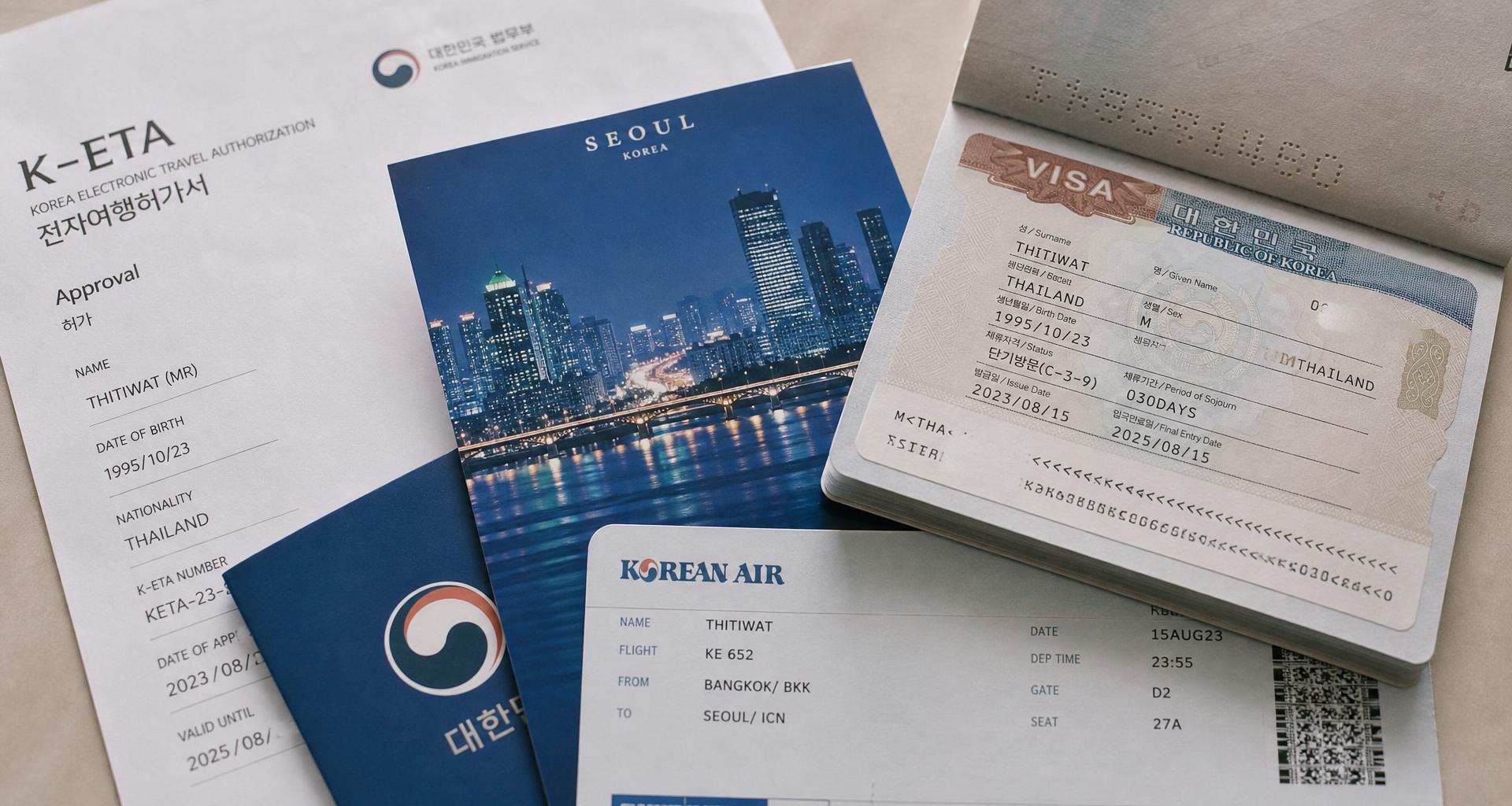
South Korea's F-6 visa is the strictest family-reunion category in Northeast Asia. As of 2026, the Thai spouse must pass KIIP Level 1 Korean language test (or hold TOPIK 1) AND the Korean spouse must show KRW 20.5M proven annual income (2.7M monthly) for the prior year, own or lease housing of ≥14 m² per person, and submit a clean criminal record. Embassy Bangkok schedules an in-person interview (separate-room joint format) within 4–6 weeks of submission. Refusal rate for Thai applicants in 2025 was 18 percent — almost entirely on income or language grounds.
- ▸KIIP Level 1 OR TOPIK 1 — non-negotiable since 1 April 2024
- ▸Korean spouse income ≥ KRW 20.5M/yr (KRW 27M if 2 dependents)
- ▸Housing proof — ownership deed or lease ≥ 14 m²/person
- ▸Korean spouse clean criminal record — past 5 years
- ▸Embassy Bangkok interview — 4–6 weeks, separate-room joint format
สรุปสั้น: Korea Visa
"Complete 2026 guide to South Korea's F-6 Marriage Migrant Visa from Thailand: KIIP Level 1 language requirement, KRW 20.5M household income floor, Korean spouse criminal record + housing proof, Embassy Bangkok interview script, and the post-2024 stricter background investigation rule."
- 01Can we apply if the Korean spouse earned less than KRW 20.5M last year?
- Exemptions exist but are narrow: (a) the Korean spouse has KRW 60M+ in liquid assets (bank statement + asset declaration); (b) a joint sponsor (Korean spouse's parent or sibling) with sufficient income co-signs a financial support pledge under 출입국관리법 §90; (c) the Korean spouse has a confirmed job offer with start date showing future income will exceed the floor. Without one of these, the application will be refused. iVC's assessment service screens for exemption eligibility before filing.
- 02Does TOPIK 2 or higher waive the KIIP requirement?
- Yes. TOPIK level 1 minimum satisfies the language gate. Higher TOPIK (2, 3, 4) provides additional benefits: TOPIK 3+ waives KIIP attendance entirely after arrival; TOPIK 4+ shortens F-5 permanent residency conversion from 2 years to 1 year. Most Thai applicants find KIIP Level 1 (40-hour assessment) easier than full TOPIK because KIIP focuses on functional Korean for daily life.
- 03What if we married while the Thai partner was on E-9 work visa in Korea?
- Marriage on E-9 does not automatically convert to F-6. The F-6 must still be applied for via Visa Issuance Confirmation, but you can apply within Korea (status change) without leaving — this is faster (3–4 weeks) and skips Embassy Bangkok. However, E-9 workers in industries with employer-control concerns (fishing, agriculture, certain manufacturing) face additional scrutiny under the 2023 anti-trafficking enhancement. iVC handles in-Korea status change via partner Korean immigration attorney.
แหล่งข้อมูล:iVC — International Visa Center · ข้อมูลปรับปรุง 2026
Step 1 — Korean spouse files Visa Issuance Confirmation (사증발급인정서) in Korea
Unlike most Korean visas, the F-6 requires the Korean spouse to file the application first at the local Korean Immigration Service (출입국·외국인청) in their hometown. Required: marriage certificate (Korean translation + Apostille from Thailand post-1 Jan 2026), proof of income (KRW 20.5M/yr — bank statements, employment certificate, tax filing 근로소득원천징수영수증), housing proof (등기부등본 ownership deed OR 임대차계약서 lease), Korean spouse's 신원증명서 (clean criminal record from National Police Agency, valid 3 months), and 가족관계증명서 family relationship certificate. Processing 4–6 weeks. On approval, immigration issues Visa Issuance Number (사증발급인정번호) which the Thai spouse uses for Embassy Bangkok application.
Step 2 — Thai spouse submits to Embassy Bangkok
With the Visa Issuance Number in hand, the Thai spouse books Embassy of Korea Bangkok appointment (online at overseas.mofa.go.kr/th-ko). Submission window 08:30–11:30 weekdays. Documents: passport (6+ months validity), F-6 application form, 4 photos (3.5x4.5 cm white background), Visa Issuance Number printout, Thai marriage certificate + Apostille + Korean translation (NAATI or MoJ Master Translator), KIIP Level 1 certificate OR TOPIK 1 certificate, Thai house registration + Apostille, Thai criminal record from RTP + Apostille (post-1 Jan 2026). Visa fee THB 1,940. Processing 5–14 working days. Interview required for first-time applicants and for couples with ≥10-year age gap.
Step 3 — Embassy interview (the make-or-break stage)
The interview is the single biggest refusal trigger. Format: separate-room joint — Thai spouse interviewed alone first, then Korean spouse separately (if present in Bangkok) or via video to Korean Immigration. Standard questions: how did you meet (date, place, who introduced); first 3 trips together (cities, hotels, who paid); Korean spouse's parents' names + occupation; daily contact pattern (KakaoTalk message frequency, video call); honeymoon location; future life plan (where you will live in Korea, who supports income). The consul cross-references answers. Inconsistency on basic facts = refusal under Article 11(1)(8) for 'sham marriage suspicion'. iVC's interview-prep package includes 90-minute mock interview in Korean with feedback transcript.
Step 4 — Arrival, Alien Registration, KIIP enrolment
On arrival in Korea, the F-6 holder must register at the local 출입국·외국인청 within 90 days for Alien Registration Card (외국인등록증). Bring passport, F-6 visa, housing lease, photo. Card issued within 2–3 weeks, fee KRW 30,000. Within 1 year, F-6 holder must complete KIIP Level 4 (Korean for Immigrants Programme — free 415-hour course at MOEL-designated centres) to be eligible for F-5 permanent residency conversion after 2 years of marriage. Without KIIP Level 4, F-6 must be renewed annually and naturalisation (취득에 의한 국적취득) is blocked.
What changed in 2024–2026 — the stricter screening era
Three major tightenings since April 2024: (1) Language requirement raised from KIIP-exempt to mandatory KIIP Level 1 OR TOPIK 1 for ALL applicants except those with Korean university degree or 1+ year prior legal stay in Korea. (2) Income floor raised from KRW 18.4M (2023) to KRW 20.5M (2026), recalculated annually based on Ministry of Health 4-person household poverty line × 100 percent. (3) Background investigation extended — Korean spouse's prior marriage history checked; if Korean spouse divorced an F-6 holder within past 5 years AND new F-6 application is for same-nationality spouse, automatic re-investigation triggered (the '5-year same-nationality rule' against serial international marriage). Embassy Bangkok 2025 refusal rate for Thai applicants 18 percent, up from 11 percent in 2022.
คำถามที่พบบ่อย
- Can we apply if the Korean spouse earned less than KRW 20.5M last year?
- Exemptions exist but are narrow: (a) the Korean spouse has KRW 60M+ in liquid assets (bank statement + asset declaration); (b) a joint sponsor (Korean spouse's parent or sibling) with sufficient income co-signs a financial support pledge under 출입국관리법 §90; (c) the Korean spouse has a confirmed job offer with start date showing future income will exceed the floor. Without one of these, the application will be refused. iVC's assessment service screens for exemption eligibility before filing.
- Does TOPIK 2 or higher waive the KIIP requirement?
- Yes. TOPIK level 1 minimum satisfies the language gate. Higher TOPIK (2, 3, 4) provides additional benefits: TOPIK 3+ waives KIIP attendance entirely after arrival; TOPIK 4+ shortens F-5 permanent residency conversion from 2 years to 1 year. Most Thai applicants find KIIP Level 1 (40-hour assessment) easier than full TOPIK because KIIP focuses on functional Korean for daily life.
- What if we married while the Thai partner was on E-9 work visa in Korea?
- Marriage on E-9 does not automatically convert to F-6. The F-6 must still be applied for via Visa Issuance Confirmation, but you can apply within Korea (status change) without leaving — this is faster (3–4 weeks) and skips Embassy Bangkok. However, E-9 workers in industries with employer-control concerns (fishing, agriculture, certain manufacturing) face additional scrutiny under the 2023 anti-trafficking enhancement. iVC handles in-Korea status change via partner Korean immigration attorney.
- Is same-sex marriage recognised for F-6?
- No. As of 2026, South Korea does not recognise same-sex marriage and the F-6 category requires marriage under Korean Civil Act §812 which restricts marriage to 'husband and wife'. Same-sex Thai-Korean couples (Thailand legalised same-sex marriage on 23 Jan 2025) cannot use F-6. Alternative pathway: Korean partner sponsors via D-10 (job seeker), E-7 (specialty occupation), or F-2 (long-term resident) for the Thai partner based on their own qualifications, with no spousal recognition.
- How long until I can naturalise as Korean?
- Three years from F-6 issuance for marriage migrants (취득에 의한 국적취득 special naturalisation under Nationality Act §6), provided you maintain marriage, pass the naturalisation test (Korean language + Korean culture + civic knowledge), and have completed KIIP Level 5 OR hold TOPIK 4+. Most Thai F-6 holders achieve naturalisation between year 3 and year 5. Dual nationality is permitted for marriage migrants who naturalise — Thailand allows dual nationality by birth or by naturalisation acquired through marriage.
- How does iVC help with F-6 from Thailand?
- iVC's F-6 Marriage Migrant Package (THB 45,000–85,000) covers: (1) document audit + gap analysis before Korean spouse files; (2) certified Korean translation of all Thai civil documents (marriage cert, birth cert, house registration, criminal record) — translator listed on Korean court translator roster; (3) Apostille of all Thai documents post-1 Jan 2026; (4) Embassy Bangkok appointment booking; (5) 90-minute mock interview in Korean with recorded feedback; (6) interview-day accompaniment to embassy; (7) on-arrival Alien Registration support via Seoul partner office. Optional add-on: KIIP Level 1 exam preparation course (8 weeks online, THB 12,000).
จดทะเบียนสมรสในไทย vs จดทะเบียนที่ต่างประเทศแล้วบันทึกฐานะ
ทั้งสองเส้นทางมีผลทางกฎหมาย ต่างกันที่เอกสารต้นทางและลำดับการรับรอง
| ประเด็น | จดในไทย | จดต่างประเทศ |
|---|---|---|
| หน่วยงานที่จด | สำนักงานเขต/ที่ว่าการอำเภอ | หน่วยงานทะเบียนของประเทศนั้น |
| เอกสารสำคัญ | หนังสือรับรองสถานภาพจากสถานทูตของคู่สมรส + คำแปลรับรอง | ทะเบียนสมรสต่างประเทศ + Apostille/รับรองสถานทูต |
| ขั้นตอนต่อเนื่อง | ขอคัดทะเบียนสมรสเพื่อนำไปใช้ต่างประเทศ | บันทึกฐานะแห่งครอบครัวที่เขต/สถานทูตไทย |
| ใช้ต่อกับวีซ่า | ใช้ประกอบวีซ่าคู่สมรสได้เมื่อรับรองครบ | เหมือนกัน หลังบันทึกฐานะเรียบร้อย |
ทำเอง vs ให้ iVC ดูแลให้ทั้งกระบวนการ
ทั้งสองทางทำได้จริง ต่างกันที่เวลาที่คุณต้องใช้ ความเสี่ยงที่เอกสารถูกตีกลับ และการมีที่ปรึกษาคอยตรวจก่อนยื่น
| ประเด็น | ดำเนินการเอง | ให้ iVC ดูแล |
|---|---|---|
| การตรวจเอกสารก่อนยื่น | ตรวจเองจากข้อมูลหน้าเว็บหน่วยงาน | ที่ปรึกษาตรวจทีละฉบับตามข้อกำหนดปลายทางก่อนยื่นจริง |
| เวลาที่คุณต้องใช้ | เดินทาง ต่อคิว และติดตามผลด้วยตัวเอง | เราเดินเรื่องและติดตามให้ คุณรับรายงานความคืบหน้า |
| ความเสี่ยงตีกลับ | พบบ่อยจากการสะกดชื่อไม่ตรง เอกสารหมดอายุ หรือลำดับรับรองผิดขั้น | ตรวจจุดที่ตีกลับบ่อยตั้งแต่ต้นทาง และแก้ก่อนยื่น |
| ความรู้เฉพาะทาง | ต้องศึกษาระเบียบของแต่ละหน่วยงานเอง | ทีมงานประสบการณ์ 15+ ปี ให้คำปรึกษาตลอดเคส |
| กรณีเอกสารมีปัญหา | ต้องเริ่มขั้นตอนใหม่ด้วยตัวเอง | เราประเมินทางเลือกและวางแผนแก้ให้ทันที |
เราทำงานแบบที่ปรึกษา ไม่ใช่แค่รับเดินเอกสาร
ประสบการณ์มากกว่า 15 ปี (ตั้งแต่ปี 2554) กับงานแปล รับรองเอกสาร และเตรียมเอกสารประกอบวีซ่า ทำให้เราเห็นรูปแบบที่เอกสารถูกตีกลับซ้ำ ๆ และวางแผนตั้งแต่ต้นทางเพื่อลดโอกาสนั้น
- ประเมินเคสก่อนเริ่ม
- ดูโปรไฟล์ ประเทศปลายทาง และหน่วยงานผู้รับ ก่อนบอกว่าต้องใช้เส้นทางรับรองแบบใด
- วางแผนเอกสารรายบุคคล
- จัดลำดับว่าเอกสารใดต้องคัดใหม่ ใดต้องแปลก่อน และใดต้องรับรองก่อนหลัง
- เตือนความเสี่ยงล่วงหน้า
- แจ้งจุดที่มักถูกตีกลับ เช่น การสะกดชื่อไม่ตรงหนังสือเดินทาง หรืออายุเอกสารที่หน่วยงานปลายทางกำหนด
- ติดตามจนจบเคส
- รายงานความคืบหน้าเป็นระยะ และประเมินทางเลือกทันทีหากหน่วยงานขอเอกสารเพิ่ม
- ปรึกษาต่อเนื่องหลังงานเสร็จ
- เอกสารชุดเดิมมักถูกใช้ซ้ำในขั้นตอนถัดไป เราช่วยดูว่ายังใช้ได้หรือต้องคัดใหม่
ถ้าไม่อยากเสียเวลาไล่ขั้นตอนเอง ส่งรายละเอียดเคสมาให้เราประเมินก่อนได้ แล้วค่อยตัดสินใจ
คู่มือปฏิบัติ: จดทะเบียนสมรส / ทะเบียนครอบครัวระหว่างประเทศ
การจดทะเบียนสมรสกับชาวต่างชาติในไทยทำที่สำนักทะเบียนอำเภอ/เขต โดยต้องมีหนังสือรับรองสถานภาพจากสถานทูตของฝ่ายต่างชาติ แปลและรับรองที่กรมการกงสุลก่อน (กฎหมายสมรสเท่าเทียมมีผลบังคับใช้ 22 มกราคม 2568)
รายการเอกสารที่ต้องเตรียม
- หนังสือรับรองความเป็นโสด/สถานภาพการสมรส จากสถานทูตของฝ่ายต่างชาติ
- คำแปลภาษาไทยที่ผ่านการรับรองจากกรมการกงสุล
- หนังสือเดินทางของฝ่ายต่างชาติ และบัตรประชาชน/ทะเบียนบ้านของฝ่ายไทย
- หลักฐานการหย่าหรือใบมรณบัตรของคู่สมรสเดิม (ถ้าเคยสมรส)
- พยานบุคคล 2 คน พร้อมบัตรประชาชน
ขั้นตอนและวิธีการ
1. ขอหนังสือรับรองที่สถานทูต
ฝ่ายต่างชาติยื่นขอหนังสือรับรองสถานภาพจากสถานทูตของตนในไทย
กรอบเวลาโดยประมาณ: 1–10 วันทำการ
2. แปลและรับรองนิติกรณ์
แปลเป็นไทยและยื่นรับรองที่กรมการกงสุล
กรอบเวลาโดยประมาณ: 2–5 วันทำการ
3. จดทะเบียนที่สำนักทะเบียน
คู่สมรสและพยานไปแสดงตนที่อำเภอ/เขต เพื่อจดทะเบียนและรับ คร.2/คร.3
กรอบเวลาโดยประมาณ: 1 วัน
4. แปลทะเบียนสมรสเพื่อใช้ต่างประเทศ
แปลอังกฤษ รับรองกรมการกงสุล และขอ Apostille หรือรับรองสถานทูตตามปลายทาง
กรอบเวลาโดยประมาณ: 3–7 วันทำการ
คำแนะนำจากงานจริง
- ตรวจอายุหนังสือรับรองสถานภาพ — หลายสำนักทะเบียนรับเฉพาะที่ออกไม่เกิน 3 เดือน
- จองล่ามกรณีฝ่ายต่างชาติสื่อสารภาษาไทยไม่ได้ นายทะเบียนหลายแห่งกำหนดให้มีล่าม
ข้อควรระวัง
- หญิงที่สมรสเดิมสิ้นสุดยังอาจมีเงื่อนไขเรื่องระยะเวลาตามประมวลกฎหมายแพ่งและพาณิชย์ ควรตรวจสอบก่อน
- การจดทะเบียนไม่ได้ทำให้ได้สิทธิพำนักหรือวีซ่าโดยอัตโนมัติ ต้องยื่นขอแยกต่างหาก
ให้ iVC ดำเนินการแทนคุณ
ถ้าไม่อยากเสียเวลาเดินเรื่องเอง ทีมงาน iVC รับดำเนินการให้ครบวงจร ตั้งแต่ตรวจเอกสาร แปล รับรอง จนถึงยื่นและติดตามผล — ทักไลน์ @iVisa หรือโทร 080-557-8887 เพื่อให้เราประเมินเคสของคุณก่อนเริ่มงาน
แหล่งอ้างอิงทางการ
ปรึกษาเรื่องนี้กับ iVC
ทีมที่ปรึกษา 15+ ปี · ครอบคลุม 60+ ประเทศ · LINE ตอบทุกวัน
ปรึกษาฟรี LINE @iVisaเผยแพร่ 2026-08-07 · ปรับปรุง 2026-08-07 · เขียนโดย Sumin K., iVC (Korea Desk Lead · ex-Korean Embassy Bangkok visa section · 9 yrs)