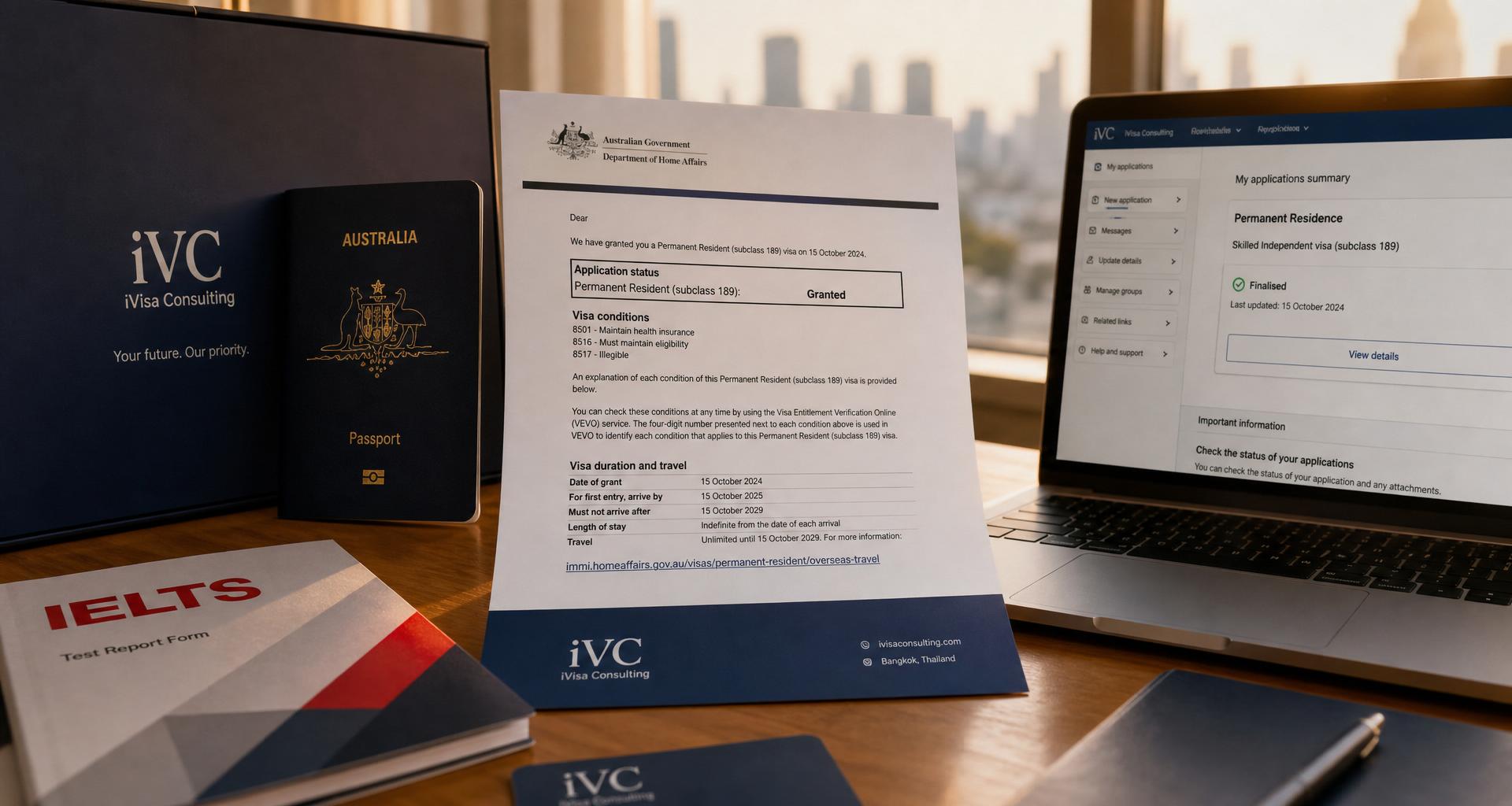
How is Spouse Visa Australia completed without travelling to Bangkok?
The certified original travels instead of the applicant: courier to Bangkok, translation and certification, then return delivery. Provincial consular counters exist in some regions and can shorten this further.
Provincial handling of Spouse Visa Australia
The certified original travels instead of the applicant: courier to Bangkok, translation and certification, then return delivery. Provincial consular counters exist in some regions and can shorten this further.
Confirm which counter is currently open for Spouse Visa Australia before dispatch, since regional service hours and document categories differ from the Bangkok office.
How marriage, family and spouse-document services works
A foreign national normally needs an affirmation of freedom to marry issued or notarised by their own embassy in Thailand, translated into Thai and certified by the Department of Consular Affairs before the registrar will accept it.
To use a Thai marriage certificate abroad the reverse chain applies: certified translation, then Apostille or legalisation by the Department of Consular Affairs, and where the destination is not an Apostille member, a final stamp by that country's embassy.
Thailand's Marriage Equality Act took effect in January 2025, so marriage registration at a district office is open to couples regardless of gender. The registration itself is performed by the registrar at the amphoe or khet office, not by an embassy.
Where Spouse Visa Australia fits in the document chain
Documents connected with Spouse Visa Australia move through a fixed chain: issuance, translation, certification and acceptance. Each link is verified against the previous one, which is why a missing intermediate stamp cannot be repaired at the final counter.
Because marriage registration, family documents and their use abroad is assessed on paper, the safest working method is to prepare the complete set before approaching any office, then submit once with everything attached.
Evidence the reviewing officer looks for
An officer checks four things: that the original is authentic and current, that the translation is complete, that the certifications appear in the correct order, and that the person submitting is entitled to do so.
None of those four is a formality. A file that satisfies three of them is still returned, and the queue restarts from the beginning.
Planning a realistic timeline for Spouse Visa Australia
Work backwards from the date the finished file is actually needed. Start with the office that issues or certifies the underlying original, allow a separate block of working days for translation and proofreading against the source, then a further block for the district office (amphoe / khet) for registration to process the certification or submission stage.
A file for Spouse Visa Australia rarely fails because one stage is slow - it fails because two slow stages were scheduled to run at the same time instead of back to back. Build in a buffer of a few working days around public holidays and around any stage that depends on a document arriving from abroad by post or courier.
Document checklist specific to Spouse Visa Australia
Beyond the general pre-submission checklist, a file built around Spouse Visa Australia typically needs the triggering original itself, a government-issued photo identity document for every named party, proof of the relationship or authority linking the applicant to the document (such as a power of attorney or a civil-status certificate), and a certified translation where the receiving office does not work in the source language.
Keep every supporting item in its own labelled folder - original, translation, certification receipts - rather than merging them into one stack. When marriage, family and spouse-document services involves more than one office, a reviewer at the second office usually asks to see the first office's receipt before accepting the file, so losing that receipt can force the first stage to be repeated.
Mistakes that are specific to Spouse Visa Australia, not just document work in general
The pitfalls that recur across marriage, family and spouse-document services - a name mismatch, an expired original, an incomplete translation - also show up in cases involving Spouse Visa Australia, but two further mistakes are specific to this topic: assuming a template answer that worked for a different subject under marriage, family and spouse-document services will also satisfy the district office (amphoe / khet) for registration for Spouse Visa Australia, and assuming that because one office accepted a document once, the same office will accept an identical document the same way a second time without checking current rules.
Rules administered by the district office (amphoe / khet) for registration are revised without public notice more often than most applicants expect. Before relying on an answer found for a similar case, confirm it still applies to Spouse Visa Australia specifically, on the date the file is being prepared.
Working with IVC
IVC has handled marriage registration, family documents and their use abroad - more than fourteen years of files across translation, notarisation, consular certification and submission support. We prepare, check and track the chain; the decision always remains with the authority, and we never promise an outcome.
Fees depend on document type, language pair, volume and urgency, so they are quoted by our staff rather than published. Contact us by phone, LINE or email with a scan of the document and the destination, and you will get a written scope before anything starts.
Pre-submission checklist
- Confirm in writing what the receiving authority accepts today
- Use the certified original or an officially sealed copy, never a plain photocopy
- Match the spelling of every name to the passport, letter for letter
- Translate the whole document including seals, stamps and handwritten notes
- Keep the certification order: issuer, translator, consular authority, embassy
- Check validity dates on every supporting document on the day of submission
- Carry identity documents for every named party and for the representative
Common pitfalls
- Letting a passport change break the match with an issued document
- Splitting a document set between offices and losing an intermediate stamp
- Treating one authority's acceptance as binding on another
- Starting the chain from an uncertified photocopy
- Omitting seal or annotation text from the translation
Official sources
- Department of Provincial Administration — Civil registration
- Department of Consular Affairs, Ministry of Foreign Affairs (Thailand) — Legalisation and Apostille services
- HCCH — Apostille Convention status table
Information reviewed as of August 2026.
Practical playbook: International Marriage and Family Registration
Marrying in Thailand as a foreign national normally requires an affirmation of freedom to marry from your embassy, MFA legalisation of that affirmation with a Thai translation, and registration at a district office (amphoe).
Documents to prepare
- Embassy affirmation or certificate of no impediment
- Certified Thai translation of the affirmation
- Passports of both parties (and Thai ID card / house registration for the Thai party)
- Divorce or death certificates for previous marriages, where applicable
- Two witnesses with photo ID at the district office
Steps and method
1. Obtain the embassy affirmation
Book with your embassy in Bangkok and bring the identity and civil-status evidence it lists.
Typical timeframe: 1–10 business days
2. Translate and legalise
Translate into Thai and legalise the affirmation and translation at the Department of Consular Affairs.
Typical timeframe: 2–3 business days
3. Register at the district office
Both parties attend with witnesses; the marriage certificate is issued the same day in most districts.
Typical timeframe: Same day
4. Prepare the certificate for overseas use
Translate the Thai marriage certificate and add MFA legalisation plus Apostille or embassy legalisation.
Typical timeframe: 3–10 business days
Consultant tips
- Since January 2025 Thailand registers marriages for couples of any gender under the equal marriage law.
- Some district offices ask for an appointment or extra evidence; confirm the day before.
Pitfalls to avoid
- An affirmation that is not legalised in Thai will not be accepted at the district office.
- Inconsistent transliteration of names across documents frequently blocks registration.
Official references
If you would rather not handle the paperwork yourself, the iVC team can run the whole file end to end — document review, translation, certification, submission and follow-up. Contact us by LINE @iVisa or call 080-5578887 so we can assess your case before any work starts.
Marrying in Thailand vs registering abroad and recording it
Both are legally valid; they differ in source documents and certification order.
| Aspect | Registered in Thailand | Registered abroad |
|---|---|---|
| Registrar | District office (khet/amphoe) | That country's registry authority |
| Key documents | Affirmation of freedom to marry from the embassy plus certified translation | Foreign marriage certificate plus Apostille or legalization |
| Follow-up step | Obtain certified copies for overseas use | Record family status at a district office or Thai embassy |
| Use for visas | Accepted once certification is complete | Same, after the family status record is done |
Doing it yourself vs having iVC manage the whole process
Both routes are valid. They differ in the time you spend, the risk of documents being returned, and whether an adviser reviews everything before submission.
| Aspect | Do it yourself | Managed by iVC |
|---|---|---|
| Pre-submission review | You check against the agency's published requirements | An adviser checks each document against the destination's rules first |
| Your time | You travel, queue and follow up yourself | We file and follow up; you receive progress updates |
| Rejection risk | Common causes: name spelling mismatch, expired documents, wrong certification order | We check the usual rejection triggers at source and fix them first |
| Specialist knowledge | You research each agency's rules yourself | Our team advises throughout |
| If something goes wrong | You restart the steps yourself | We assess the options and plan the fix immediately |
We work as advisers, not just a document courier
More than 15 years of casework (since 2011) in translation, certification and visa document preparation shows us the patterns behind repeated rejections, so we plan around them from the start.
- Case assessment first
- We review the profile, destination country and receiving authority before recommending a certification route.
- A document plan per person
- We sequence what must be re-issued, translated first, and certified in which order.
- Risks flagged early
- We point out the usual rejection triggers, such as name spelling that differs from the passport or document age limits.
- Follow-through to the end
- Regular progress updates, and immediate options if the authority requests more documents.
- Advice after completion
- The same set is often reused in the next step; we check whether it still qualifies or needs re-issuing.
If you would rather not chase each step yourself, send the case details for an assessment first, then decide.
Thai version: /mrg-q/mq-th-spouse-visa-australia-upcountry
Need this handled end to end?
Talk to our team by phone, LINE or email for a case-specific answer and a quotation.